
MAPS Canada regularly hosts webinars featuring leading experts from around the world. Find out more about our upcoming webinars or watch past webinars!
MAPS CANADA UPCOMING WEBINARS
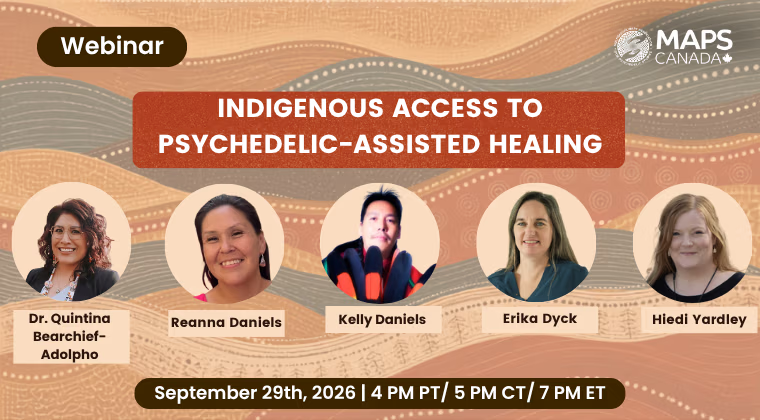
September, 29, 2026
MAPS Canada presents:
Indigenous Access to Psychedelic-Assisted Healing
This webinar will explore the connection between Indigenous healing traditions, the Native American Church, and access to PAT in Canada.
This webinar will explore the connection between Indigenous healing traditions, the Native American Church, and the emerging field of psychedelic-assisted therapy (PAT) in Canada.
Indigenous communities have long-standing relationships with plant medicines, ceremony, and holistic healing frameworks currently in use that predate and in many ways anticipate what Western clinical models are now acknowledging and rediscovering.
In relation to regulated PAT, Indigenous communities face distinct and compounding barriers to access: geographic isolation, jurisdictional gaps in funding, a legacy of medical mistrust rooted in colonial healthcare harms, and a workforce that is unprepared to support Indigenous cultural safety.
Through stories, teachings, discussion and song, this session will bring together clinical, cultural, and policy perspectives to examine how psychedelics are being utilized for healing, and how collaboration is essential to bridge connection and learning.
Objectives:
- Learn about different approaches to Indigenous psychedelic-assisted healing
- Describe how traditional healing practices inform and align with contemporary psychedelic-assisted therapy models.
- Explore the components of Indigenous psychedelic-assisted healing
- Understand the historical and legal context of these practices
- Identify barriers to access to different practices for different individuals and communities
Check out all of our past webinars on the School of Psychedelics!
MAPS CANADA PREVIOUS WEBINARS
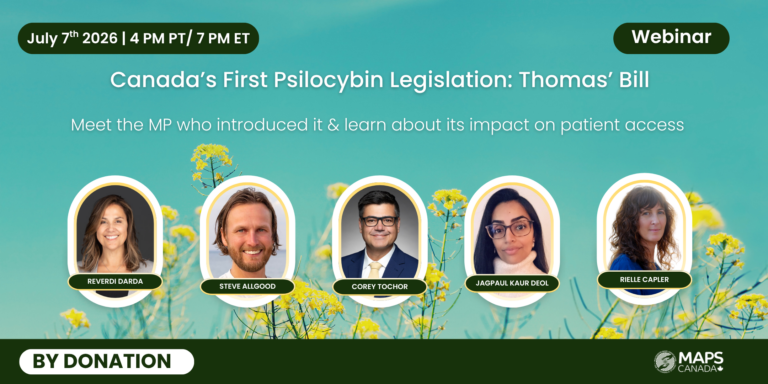
July 7, 2026
MAPS Canada presents:
Canada’s First Psilocybin Legislation: Thomas’ Bill
Join us to learn about MP Tochor’s motivation for introducing Thomas’ Bill and its impact on patient access and the health care system
Join us to learn about MP Corey Tochor’s motivation for introducing Thomas’ Bill, its impact on patient access, the health care system, and the future of legal access to psychedelics in Canada.
Inspired by the experience of Thomas Hartle, a constituent who used psilocybin to manage severe anxiety during cancer treatment, Thomas’ Bill represents an important step toward improving access to evidence-based psychedelic-assisted therapies for mental health and other qualifying conditions.
Sign the petition for Thomas’s bill here.

June 25, 2026
MAPS Canada presents:
Straight from the Source: Hear from Canada’s Psychedelic Manufacturers
Get the inside scoop on Canada’s psychedelic industry: who’s making what, what’s in demand, and what’s coming next. Direct from the source.
Join MAPSC Canada for an exclusive conversation with leaders from some of Canada’s licensed psychedelic manufacturers. Hear from the people behind the molecules to explore what’s being made, who’s using it, and what the future of legal psychedelics may hold in Canada and beyond.
Objectives:
Attendees will learn:
- which psychedelic substances are currently being legally produced in Canada and for what purposes
- current and emerging therapeutic and research applications of legal psychedelics
- key challenges facing psychedelic producers in the Canadian regulatory environment
- how industry leaders see the landscape evolving over the next one to five years
Panelists:
Nick Kadysh – CEO, PharmAla Biotech
With over a decade of experience as a Public Affairs and Regulatory expert, Nick Kadysh is the founder and CEO of PharmAla Biotech, and a leading consultant in the intersection of pharmaceutical development and consumer products.
Prior to launching PharmAla in 2020, Nick led government relations and regulatory departments for several large corporations, including as Head of Corporate Affairs for JUUL Labs, as Government Affairs & Public Policy Leader for General Electric Canada, and as Director of Public Affairs for Red Bull Canada.
Nick gained a deep understanding of government as a campaign and legislative staff member in multiple levels of government prior to joining the corporate sector, most recently directing the Outreach department of the Office of the Leader of the Opposition at Queen’s Park in Toronto. He has also worked as a policy advisor at the Parliament of Canada.
Nick is trilingual (English, French & Russian) and is a graduate of Queen’s University. He lives in East Toronto with his wife, Olga, and two daughters, Milena and Sasha. He is active in non-profit and community initiatives in Toronto, including fundraising for Toronto East General Hospital and as a member of the board for Yonge-Dundas Square.
Roya Barghian – Mycologist & Master Grower, Shields Pharma Inc.
Roya Barghian is a Senior Research Scientist in the Psychedelic Division at Shields Pharma Inc., a Health Canada–approved and GMP-approved contract testing laboratory recognized for its advanced scientific, analytical, and regulatory capabilities.
With a background in psychology and mycology, Roya specializes in the development and production of pharmaceutical-grade Psilocybe strains for therapeutic applications targeting conditions such as depression, anxiety, addiction, PTSD, ADHD, chronic pain, and suicidal ideation. She has developed eight proprietary Psilocybe strains with validated psilocybin concentrations exceeding 2.2%, demonstrating strong batch-to-batch consistency and reproducibility.
Her work spans the full production lifecycle—from genetic optimization and cultivation to analytical validation, formulation, and pharmaceutical-grade encapsulation under GMP and GACP standards. While synthetic approaches can also be supported, Roya’s primary focus is advancing a botanical approach to psychedelic medicine through the standardized cultivation and encapsulation of naturally derived Psilocybe biomass for both micro-dosing and macro-dosing applications.
Beyond research and manufacturing, Roya actively collaborates with clinics, universities, and healthcare organizations to support the responsible advancement of psychedelic medicine and clinical innovation. She is also a strong advocate for improving safe and equitable access to psychedelic-assisted therapies for veterans, first responders, and individuals facing severe mental health challenges.
Danny Motyka – Co-Founder & CEO, Psygen
Danny is a long-time proponent for the use of psychedelic medicines. His academic background in chemistry, professional career in operations management and strategic planning, and his strong understanding of controlled substance regulations were all intentionally curated skills to build Psygen. Danny truly believes that psychedelics are important tools to transform and improve the world.
Hosts
Sonia Brodie – Board Member, MAPS Canada
Sonia is a long-standing clinical research enthusiast with a wealth of experience in operationalizing pharmaceutical and medical device trials. Her technical experience spans from protocol development, to regulatory applications, efficient study start-up processes, clinical trial management, establishing quality management systems and standard operating procedures, data analysis, and knowledge translation across a wide range of study types and interventions.
She has consulted and advised on a variety of psychedelic research initiatives, including the world’s largest microdosing study, and established three clinical trials sites for psychedelic research for several global Phase II and III randomized controlled trials, balancing pharmaceutical rigor with a strong understanding of the unique considerations for psychedelic research. As Director of Growth and Partnerships with CaRe Clinics, her focus is on building and nurturing collaborative relationships with industry sponsors, CROs, healthcare providers, and policy makers to help bring more clinical trials to Canada. She is also on the board of directors for MAPS Canada.
Rielle Capler – Executive Director, MAPS Canada
Rielle Capler (MHA, PhD) has over 20 years of experience in the cannabis field, where she engaged in research, advocacy, knowledge translation, service provision, standards development, and community organizing. Rielle received the Governor General of Canada’s Queen Elizabeth II Diamond Jubilee Medal acknowledging her contribution to Canadian society through her work with medical cannabis. She has been engaged in psychedelics research for over 10 years, and in psychedelic-related education, advocacy and leadership for the past 4 years.
Rielle earned a PhD in Interdisciplinary Studies at the University of British Columbia, focused on access to medical cannabis under different regulatory frameworks in Canada. She has published various research articles and book chapters, and held a postdoctoral research fellowship at the B.C. Centre on Substance Use. She is an Adjunct Professor in the School of Population and Public Health, in the Faculty of Medicine at the University of British Columbia. Rielle was on the board of MAPS Canada for 3 years, and has been the Executive Director of MAPS Canada for the past year.
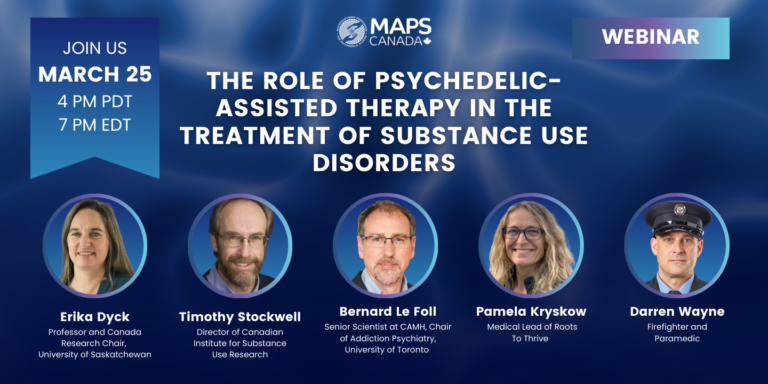
March 25, 2026
MAPS Canada presents:
The role of psychedelic-assisted therapy for substance use disorders
Join MAPS Canada to explore the relationship between psychedelic-assisted therapy and substance use disorders.
Treating substance use disorders is one of the most pressing issues in Canada. Every year, substance use disorders kill thousands of Canadians and cost the healthcare and criminal justice systems billions of dollars. While conventional treatment methods remain the frontline option, psychedelic-assisted therapy has shown significant potential in treating challenging cases of substance use disorder.
This webinar will bring together an expert in drug-related harm, a psychiatric historian, a clinical researcher, a physician, and a firefighter with lived experience to provide a comprehensive discussion on the role of psychedelic-assisted therapy in the treatment of substance use disorders.
Learning Objectives
- Understand the burden of substance use disorders in Canada
Understand the negative impact of substance use disorders, with a particular spotlight on alcohol and opioids, and their related social costs and harms in Canada. - Explore harm reduction policies and traditional treatments
Learn about policies and interventions that can increase or decrease substance use related harms as well as the best known traditional treatment methods. - Discover the Canadian history of psychedelic-assisted therapy for alcohol use disorder
Gain an understanding of the history of psychedelic-assisted therapy as a treatment method for alcohol use disorder in Canada. - Review current Canadian clinical trials
Discover current clinical trials in Canada that are gathering scientific evidence on the efficacy of psychedelic-assisted therapy on substance use disorders. - Examine an upcoming psilocybin trial at CAMH
Gain an in-depth understanding on the research design of an upcoming clinical trial at Toronto’s CAMH on the impact of psilocybin on patients with major depressive disorder and alcohol use disorder. - Understand the mechanisms of psychedelic-assisted therapy
Explore the neurological, psychological and spiritual mechanisms by which psychedelic-assisted therapy treats substance use disorder. - Navigate legal pathways and barriers to access
Understand current legal pathways and existing barriers for access to psychedelic-assisted therapy for substance use disorders. - Hear from lived experience
Find out from someone with lived experience treating their substance use disorder with psychedelic-assisted therapy how it improved their life.
Panelists:
Erika Dyck – Professor and Canada Research Chair, University of Saskatchewan
Erika Dyck is a Professor and a Canada Research Chair in the History of Health & Social Justice. Her interdisciplinary research brings social sciences and humanities perspectives to scientific and medical subjects. Her work has been published in medical, legal, economic, literary, philosophical, anthropological and historical venues. She is the author or editor of several books, including: Psychedelic Psychiatry: LSD from Clinic to Campus. She is an expert on the history of psychedelics in Canada, including clinical trials of psychedelic-assisted therapy for alcohol use disorder in the prairies in the 20th century
Timothy Stockwell – Director of Canadian Institute for Substance Use Research
Tim held the position of director of the Canadian Institute for Substance Use Research (CISUR, formerly the Centre for Addictions Research of BC) from its inception in 2004 until 2020. He has also been a professor in the Department of Psychology at the University of Victoria since 2004. Tim is committed to the advancement of public policy on substance use issues, and has established CISUR as a research institute which aims to shed light on the social, cultural and psychological determinants of harmful substance use, which applies rigorous measures of patterns of use and related harms, and which advances knowledge of effective policy and practice.
Bernard Le Foll – Senior Scientist at CAMH, Chair of Addiction Psychiatry University of Toronto
Dr Bernard Le Foll, MD PhD MCFP (AM), is a clinician-scientist specialized in drug addiction. He is Senior Scientist at CAMH. He is Chair of Addiction Psychiatry and Professor at University of Toronto. He is also the Vice-President Research and Academics and Chief Scientific Officer at the Waypoint Centre for Mental Health Care. His multi-disciplinary research approach seeks to develop better treatment for addiction and understand the addiction neurobiology. He obtained >100 grants and published around 400 peer-reviewed scientific articles. He has led multiple clinical trials, developed clinical guidelines and has been invited to speak at Senate and House of Commons on addiction related issues.He got the first CIHR grant awarded to test psilocybin for addiction treatment
Pamela Kryskow – Medical doctor & Medical Lead of Roots To Thrive
Dr. Pamela Kryskow is a medical doctor and the medical lead of the Non Profit Roots To Thrive Psychedelic Assisted Therapy Programs that treats people with PTSD, depression, anxiety, substance use challenges, disordered eating and people with end of life distress. She is a founding board member of the Psychedelic Association of Canada and the Medical Chair of the Vancouver Island University Post Graduate Certificate in Psychedelic Medicine assisted Therapy. Ongoing research includes Psilocybin, MDMA, Ketamine, microdosing (microdose.me), front line health care workers and first responders mental wellness. Prior to studying medicine she was a City of Coquitlam Firefighter for 8 years and provincial forestry firefighter for 4 seasons. In real life she loves hiking in the forest, ocean kayaking, growing kale and daydreaming in the hammock. Her heritage includes Polish, Ukrainian, and German. She currently resides in the traditional unceded territory of the Klahoose First Nations. Pronouns: She/her.
Darren Wayne – Firefighter and Paramedic
Darren spent 13 years as a firefighter and paramedic. He ignored the signs and symptoms of PTSD until he couldn’t any longer. He went on WCB leave and was treated for workplace injury. He spent the last 7 years trying to recover and return back to “himself”. Traditional therapy, EMDR and CBT didn’t get rid of the feelings plaguing his head and heart, and the trialing of several antidepressants didn’t make anything better and arguably just created new problems to deal with. Over the past year he has undergone several ketamine, MDMA, and psilocybin assisted therapy sessions.
Host:
Kyle Sittek-Lumsden
Kyle completed his bachelor of arts in political science and sociology at the University of Toronto, and Masters of Public Policy at the Munk School of Public Policy and Global Affairs where he wrote his Capstone Thesis on reducing the harm of licit and illicit substances through evidence-based public policy. He has volunteered in drug policy since 2015. He has an occupational background working for the Ontario Public Service at the Ministry of Economic Development, Job Creation, and Trade as well as previous experience working on criminological research projects and in the private education sector. Kyle became interested in the subject of treating substance use disorders with psychedelic-assisted therapy after witnessing a family member try and fail conventional treatments for alcohol use disorder.
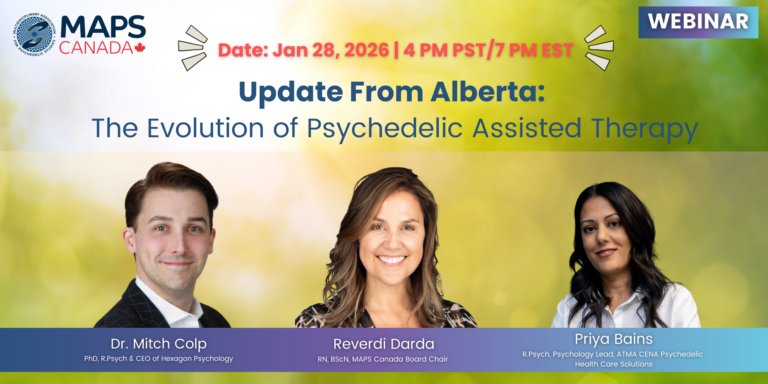
January 28, 2026
MAPS Canada presents:
Update From Alberta: The Evolution of Psychedelic Assisted Therapy
Wed, January 28th 4pm PT / 7pm ET
As psychedelic-assisted therapy (PAT) continues to develop within Canada’s regulated healthcare landscape, regulatory bodies are increasingly clarifying expectations related to competence, boundaries, accountability, and collaboration, particularly where psychotherapy intersects with medically regulated substances.
In Alberta, professional guidance from the Alberta College of Social Workers (ACSW) and expectations articulated by the College of Alberta Psychologists (CAP), make it clear that psychedelic-assisted therapy cannot be practiced in isolation. Instead, it requires interdisciplinary, team-based models of care that align psychological practice with medical oversight, ethical standards, and regulatory compliance.
This webinar will explore how evolving scope of practice and regulatory interpretation are shaping who can do what, under what conditions, and in collaboration with whom in psychedelic-assisted therapy.
Particular attention will be given to co-care and interdisciplinary models as practical, compliant pathways that support access, continuity of care, and professional integrity across disciplines.
Participants will be invited to:
- Reflect on how evolving scope of practice impacts their professional roles
- Identify where interdisciplinary models can strengthen compliance and care
- Engage with MAPS Canada’s ongoing advocacy and policy efforts to support responsible psychedelic-assisted therapy pathways
Learning Objectives
- Understand evolving scope of practice
Examine how psychology roles are expanding and being clarified in the context of PAT and identify responsibilities related to assessment, preparation, integration, and therapeutic care - Explore regulatory guidance in Alberta/Canada
Learn about the National Guidance and evolution in scope of practice, and review AB expectations regarding therapist participation within regulated, interdisciplinary frameworks - Examine interdisciplinary and co-care models
Understand why team-based care is increasingly required for compliant PAT delivery and explore how co-care models (AB specific) support ethical practice, role clarity, and shared accountability. - Translating policy into practice
Gain practical insights for clinicians, clinics, and organizations navigating evolving regulation and scope
Panelists:
Priya Bains – R. Psych. Psychology Lead, ATMA CENA Psychedelic Healthcare Solutions
Priya is a registered psychologist and has been working in collaboration with clients for nearly 20 years in Alberta. Early in her career, she was introduced to somatic therapy and trauma therapy, which sparked her curiosity about how the body holds psychological burdens and patterns. Her undergraduate degree in neuropsychology shaped her belief that everything psychological is, at its core, biological. As a Certified Hakomi Practitioner, she learned various frameworks for understanding developmental patterns and the “stuckness” clients often experience. Her work is informed by Self-Regulation Therapy, Somatic Experiencing, Attachment Theory, and Hakomi. Her curiosity later led her to explore psychedelic medicine and its potential to facilitate the softening and opening of the unconscious mind, which allows for easier access to these stuck patterns.
Priya currently works at ATMA CENA in Edmonton as a clinician on the interdisciplinary team and also provides leadership and supervision in psychedelic-assisted psychotherapy and somatic therapy.
Dr. Mitch Colp – Ph.D., R. Psych, CEO Hexagon Psychology
Dr. Mitch Colp is a Registered Psychologist and Chief Executive Officer of Hexagon Psychology. He has held senior clinical and executive leadership roles across Alberta and within national professional associations. His work focuses on psychological assessment, consultation, and intervention with children, adolescents, and adults in school and private practice settings. Dr. Colp also supports the development of training standards, ethical guidelines, and workforce frameworks in psychology. He holds academic appointments with multiple Canadian universities and regularly delivers national training in psychological assessment, ethical decision-making, and evolving regulatory and professional practice standards.
Host:
Reverdi Darda – RN, BScN , Board Chair MAPS Canada
Reverdi Darda, RN is the Founder & CEO of ATMA CENA Psychedelic Healthcare Solutions, a Canadian organization pioneering a co‑care model that pairs community therapists with robust medical oversight to deliver evidence‑based psychedelic‑assisted therapies. Drawing on 35 years of nursing and executive experience, Reverdi has built a national network of clinics and practitioners who support legal access to ketamine assisted therapy, as well as psilocybin, and MDMA assisted therapy under Health Canada’s Special Access Program. She champions interdisciplinary teamwork, culturally informed practice, and the use of digital tools to make innovative mental‑health care safe, scalable, and equitable.
An active policy advocate and MAPS Canada board member, Reverdi works to enhance access to underserved communities and advance real‑world research in psychedelic medicine.